Flagship · AI/ML · Completed
ContentEngine
A Telegram-driven pipeline that picks a de-duplicated content angle across 4 niches, writes on-brand copy, generates a photorealistic image and 4 branded slides, and — once approved from Telegram — auto-publishes to Facebook and Instagram via Make.com.
- Timeline
- 2026-05 – Present
- Status
- Completed
- end-to-end run time (idea → 4 rendered slides + caption, ready for approval)
- ~5 min
- content niches + live news-signal filter covered
- 4
- est. manual time for equivalent output
- ~3 hrs (estimated)
Stack
Built with
Core
Supporting
The problem
Posting consistently across Fintech, HR-tech, and SaaS content meant picking a genuinely new angle every time (not a repeat of the last 30 posts), writing copy that didn't read like every other 'thought leadership' account, producing an on-brand image, turning that into a branded multi-slide carousel, and actually getting it onto Facebook and Instagram. Doing all of that by hand, per post, per niche, doesn't scale past a few posts a week.
Constraints
- No budget for a human designer or stock photography, so every image is generated (Gemini 2.5 Flash Image) and every social-card slide is built as HTML/CSS and rendered to PNG, not designed by hand
- Had to guarantee no repeated topic — dedup logic checks the last 30 posts per niche for subtopic word overlap, topic_key-dimension matches, and shared-tag clusters before a strategy is accepted
- Kept a human in the loop on purpose: nothing reaches Facebook or Instagram without an explicit Approve tap in Telegram, so a bad generation never auto-publishes
Architecture
How it's built
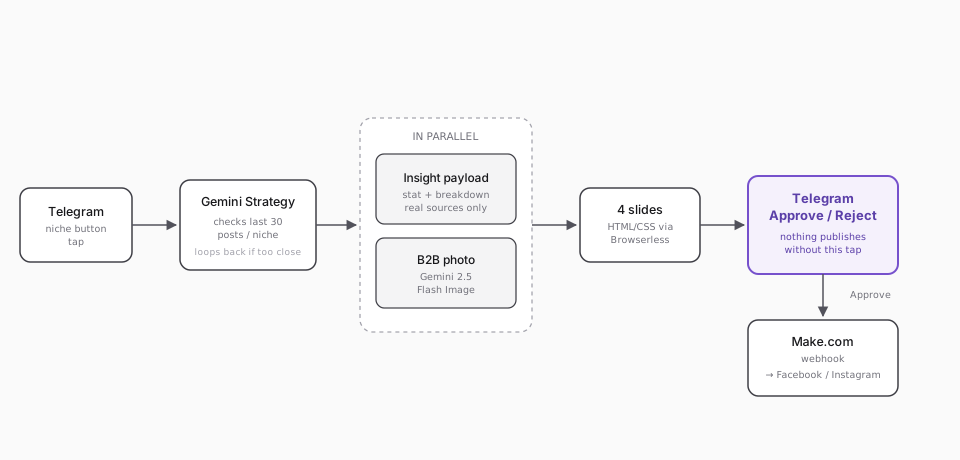
A Telegram bot is the entire interface: a Router node classifies every incoming update (niche button tap, approve/reject callback, plain text) and a Switch fans it out. Picking a niche pulls the last 30 Supabase posts for that niche and feeds them to a Gemini 'Strategy' call carrying a full taxonomy (5 content pillars × multiple subtopics per niche) plus explicit dedup rules; a code node re-checks the chosen subtopic against history (word overlap, topic_key match, tag-cluster overlap) and loops back to Gemini if it's too close to something already posted. A second Gemini call turns the approved strategy into a structured insight payload (before/after stat, a 4-point breakdown, a one-line takeaway) under strict sourcing rules — real named sources only, no fabricated numbers, nothing older than 2022. A third Gemini call writes a platform-specific caption against a banned-word list and hard character limits. In parallel, a fourth Gemini call generates a photorealistic B2B photo from a niche-aware, cinematically-varied prompt, and four separate HTML/CSS templates (cover, before/after, 4-point breakdown, closing statement) get rendered to 1080×1080 PNGs via Browserless and uploaded to Supabase storage. Every stage — strategy, insight, image, caption — has its own validation node and a bounded 3-attempt retry loop before it's allowed to fail loudly to Telegram instead of going quiet. The finished 4-slide carousel and caption go back as a Telegram media group with Approve/Reject buttons; Approve marks the Supabase record and POSTs the caption plus image URLs to a Make.com webhook, which is what actually publishes the post to Facebook and Instagram. A separate 'HSF' news-signal branch runs alongside it: pulls Bloomberg/MarketWatch, RBI, and TechCrunch RSS, deduplicates by normalized title, enriches the top story via Tavily, and runs it through a strict Gemini filter acting as a market strategist instructed to SKIP roughly 80% of headlines and only pass genuine structural shifts — the ones that pass get their own institutional-style slide and the same Telegram approval gate before publishing.
Decisions
Alternatives considered
Auto-publish straight to Facebook/Instagram with no review step
An unreviewed bad generation going out on a public brand account is worse than a slower pipeline, so every post stops at a Telegram Approve/Reject gate before Make.com ever sees it.
Decisions
Tradeoffs
- Chose Telegram as the entire control surface instead of a proper dashboard — zero UI to build or host, but every interaction (niche pick, approve, reject) has to be squeezed into button taps and callback_data strings, which is why the Router/Switch layer up front is doing real routing work, not just passing messages through.
- Render each social-card slide as HTML/CSS through Browserless rather than compositing images programmatically — slower and adds an external dependency, but on-brand typography and layout are exact and easy to restyle per niche by touching CSS, not by editing raster templates.
Honesty check
What failed
- Early versions let a single bad Gemini response (malformed JSON, a missing required field) kill the whole run silently. Every stage now has a dedicated Validate node plus a 3-attempt retry counter that clears the error and loops back to the same Gemini node — only after 3 failures does it give up and post a specific error message to Telegram instead of just going quiet.
Lessons
- A dedup check that only looks at the current batch isn't enough — it has to look at real history (the last 30 posts per niche), or the model will happily suggest something it already covered two weeks ago.
- Strict, falsifiable content rules (real named sources only, no invented numbers, banned-word lists, hard character limits) work far better as instructions to the model than as post-hoc filters — cheaper to prevent than to catch.
Future improvements
- Extend the same Approve/Reject/Make.com publish path to platforms beyond Facebook and Instagram.
- Feed published-post performance back into the Strategy prompt so pillar/topic selection is informed by what actually worked, not just by what hasn't been posted recently.